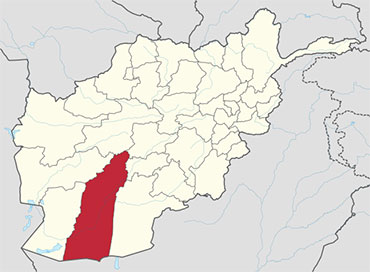
 Helmand or Hillmand is one of the 34 provinces of Afghanistan, located in the south of the country. It is the largest province by area, covering 58,584 square kilometres (20,000 sq mi) area. The province contains 13 districts, encompassing over 1,000 villages, and roughly 879,500 settled people. Lashkar Gah serves as the provincial capital.Helmand was part of the Greater Kandahar region until made into a separate province by the Afghan government in the 20th century. The province has a domestic airport, located in the city of Lashkar Gah and is heavily used by NATO-led forces. The British Camp Bastion and U.S. Camp Leatherneck are located a short distance northwest of Lashkar Gah.
The Helmand River flows through the mainly desert region of the province, providing water for irrigation. The Kajaki Dam, which is one of Afghanistan's major reservoirs, is located in the Kajaki district. Helmand is believed to be one of the world's largest opium-producing regions, responsible for around 80% of the world's total production. This is believed to be more than the whole of Burma, which is the second largest producing nation after Afghanistan. The region also produces the following: tobacco, sugar beets, cotton, sesame, wheat, mung beans, maize, nuts, sun flowers, onions, potato, tomato, cauliflower, peanut, apricot, grape, and melon.
History
Helmand culture of western Afghanistan was a Bronze Age culture of the 3rd millennium BC. It is exemplified by such major sites as Shahr-i Sokhta, Mundigak, and Bampur.
The term "Helmand civilization" was proposed by M. Tosi. This civilization flourished between 2500 BC and 1900 BC, and may have coincided with the great flourishing of the Indus Valley Civilisation. This was also the final phase of Periods III and IV of Shahr-i Sokhta, and the last part of Mundigak Period IV.
There were also links between Shahr-i Sokhta I, II and III periods, and Mundigak III and IV periods, and between the sites of Balochistan and the Indus valley at the end of the 4th millennium, as well as in the first half of the 3rd millennium BC.
Jiroft culture is closely related to Helmand culture. Jiroft culture flourished in the eastern Iran, and the Helmand culture in western Afghanistan at the same time. In fact, they may represent the same cultural area. Mehrgarh culture, on the other hand, is far earlier.
Alexander the Great
It was invaded in 330 BC by Alexander the Great and became part of the Seleucid Empire. Later, it came under the influence of the Indian emperor Ashoka, who erected a pillar there with a bilingual inscription in Greek and Aramaic. The territory was referred to as part of Zabulistan and ruled by the sun-worshipping Zunbils before the Muslim Arabs arrived in the 7th century, who were led by Abdur Rahman bin Samara. It later fell to the Saffarids of Zaranj and saw the first Muslim rule. Mahmud of Ghazni made it part of the Ghaznavids in the 10th century, who were replaced by the Ghurids.
After the destructions caused by Genghis Khan and his Mongol army in the 13th century, the Timurids established rule and began rebuilding Afghan cities. From about 1383 until his death in 1407, it was governed by Pir Muhammad, a grandson of Timur. By the early 16th century, it fell to Babur. However, the area was often contested by the Shia Safavids and Sunni Mughals until the rise of Mir Wais Hotak in 1709. He defeated the Safavids and established the Hotaki dynasty. The Hotakis ruled it until 1738 when the Afsharids defeated Shah Hussain Hotaki at what is now Old Kandahar.
In 1747, it finally submitted to Ahmad Shah Durrani and since then remained part of the modern state of Afghanistan. Some fighting took place during the 19th century Anglo-Afghan wars between the British and the local Afghans. In 1880, the British assisted the forces of Abdur Rahman Khan in re-establishing Afghan rule over the warring tribes. The area stayed calm for 100 years until the 1979 Soviet invasion of Afghanistan.
Helmand was the center of the USAID program in the 1960s to develop the Helmand and Arghandab Valley Authority (HAVA) – it became known locally as "little America". The program laid out tree-lined streets in Lashkar Gah, built a network of irrigation canals and constructed a large hydroelectric dam. The development program was abandoned when pro-Soviet Union forces seized power in 1978, although much of the province is still irrigated by the HAVA.
Recent History
More recently the USAID program has contributed to a counter-narcotics initiative called the Alternative Livelihoods Program (ALP) in the province. It pays communities to work to improve their environment and economic infrastructure as an alternative to opium poppy farming. The project undertakes drainage and canal rehabilitation projects. In 2005 and 2006, there were problems in getting promised finance to communities and this is a source of considerable tension between the farmers and the Coalition forces
It was announced in January 2006 in the British Parliament that International Security Assistance Force (ISAF) would replace the U.S. troops in the province as part of Operation Herrick. The British 16 Air Assault Brigade would be the core of the force in Helmand Province. British bases were located in the districts of Sangin, Lashkar Gah and Gereshk. British forces were replaced in Sangin by elements of the United States Marine Corps I Marine Expeditionary Force Forward.
Camp Leatherneck As of Summer 2006, Helmand was one of the provinces involved in Operation Mountain Thrust, a combined NATO-Afghan mission targeted at Taliban fighters in the south of the country. In July 2006, this offensive mission essentially stalled in Helmand as NATO, primarily British, and Afghan troops were forced to take increasingly defensive positions under heavy insurgent pressure. In response, British troop levels in the province were increased, and new encampments were established in Sangin and Gereshk. Fighting has been particularly heavy in the districts of Sangin, Naway, Nawzad and Garmsir. There were reports that the Taliban saw Helmand province as a key testing area for their ability to take and hold Afghan territory from NATO-led Afghan National Security Forces. Commanders on the ground have described the situation as the most brutal conflict the British Army has been involved in since the Korean War.
In Autumn 2006, British troops started to reach "cessation of hostilities" agreements with local Taliban forces around the district centers where they had been stationed earlier in the summer. Under the terms of the agreement, both sets of forces were to withdraw from the conflict zone. This agreement from the British forces implied that the strategy of holding key bases in the district, as requested by Afghan President Hamid Karzai, was essentially untenable with the current levels of British troop deployment. The agreement was also a setback for Taliban fighters, who were desperate to consolidate their gains in the province, but were under heavy pressure from various NATO offensives.
News reports identified the insurgents involved in the fighting as a mix of Taliban fighters and warring tribal groups who are heavily involved in the province's lucrative opium trade. Given the amount of drugs produced in the area, it is likely that foreign drug traffickers are also involved.
Fighting continued throughout the winter, with British and allied troops taking a more pro-active stance against the Taliban insurgents. Several operations were launched including the more recent Operation Silicone at the start of spring. In May 2007, Mullah Dadullah, one of the Taliban's top commanders, along with 11 of his men were killed by NATO-led Afghan forces in Helmand.
Afghan National Police station in Lashkar Gah. In April 2008, about 1,500 2nd Battalion 7th Marines occupied over 300 square miles (800 km2) of Helmand River valley and neighboring Farah Province. The operation was to set up forward operation bases and train the Afghan National Police in an area with little or no outside support.
Also in 2008, an Embedded Training Team from the Oregon Army National Guard led a Kandak of Afghan National Army troops in fighting against the Taliban in Lashkar Gah, as seen in the documentary Shepherds of Helmand.
In June 2009, Operation Panther's Claw was launched with the stated aim of securing control of various canal and river crossings and establishing a lasting ISAF presence in an area described by Lt. Col. Richardson as "one of the main Taliban strongholds" ahead of the 2009 Afghan presidential election.
In July 2009, around 4,000 U.S. Marines pushed into the Helmand River valley in a major offensive to liberate the area from Taliban insurgents. The operation, dubbed Operation Khanjar (Operation Dagger), was the first major push since U.S. President Obama's request for 21,000 additional soldiers in Afghanistan, targeting the Taliban insurgents.
In February 2013, BBC reported that corruption occurs in Afghan National Police bases, with some bases arming children, using them as servants and sometimes sexually abusing them in early March 2013, the New York Times reported that government corruption is rampant with routine accusations against the police of shaking down and sexually abusing civilians causing loyalty to the government to be weaker.
Transport and Economy
Bost Airport serves the population of Helmand for domestic flights to other parts of the country. It is designed for civilian use. NATO-led forces are heavily using the airport at Camp Bastion, where Camp Leatherneck is located nearby.
There is no rail service. Primary roads include the ring road passes through Helmand from Kandahar to Delaram. There is a major north-south route (Highway 611) that goes from Lashkar Gah to Sangin. About 33% of Helmands roads are not passable during certain seasons and in some areas there are no roads at all.
Farming is the main source of income for the majority. This includes agriculture and animal husbandry. Animals include cows, sheep, goats, and chicken. Donkeys and camels are used for labor. The province has a potential for fishery. The region produce the following: Opium, tobacco, sugar beets, cotton, sesame, wheat, mung beans, maize, nuts, sub flowers, onions, potato, tomato, cauliflower, peanut, apricot, grape, and melon.
Healthcare
The percentage of households with clean drinking water fell from 28% in 2005 to 3% in 2011. The percentage of births attended to by a skilled birth attendant increased from 2% in 2005 to 3% in 2011.
Demographics
The population of Helmand Province was reported at 879,500 in the year 2013. It is mostly a tribal and rural society, with the native ethnic Pashtuns being the majority, followed by Baloch, Tajiks, Hazaras and others as the minority. There may also be small number of Hindus and Sikhs who run businesses in the provincial capital, Lashkar Gah. The Pashtuns are divided into the following tribes: Barakzai (32%), Nurzai (16%), Alakozai (9%), and Eshaqzai (5.2%). All the inhabitants practice Sunni Islam except the small number of Hazaras who are Shi'as and the Sikhs who follow Sikhism.
Districts
Helmand province is divided in to 14 districts.
| Province | Population | Area |
|---|---|---|
| Baghran | 129,947 | 3,124 km2 |
| Dishu | 29,005 | 9,485 km2 |
| Garmsir | 107,153 | 10,345 km2 |
| Kajaki | 119,023 | 1,976 km2 |
| Khanashin | 17,333 | 13,153 km2 |
| Lashkar Gah | 201,546 | 998 km2 |
| Marjah | 2,300 km2 | |
| Musa Qala | 138,896 | 1,694 km2 |
| Nad Ali | 235,590 | 4,564 km2 |
| Nahri Saraj | 166,827 | 1,543 km2 |
| Nawa-I-Barakzayi | 300,000 | 4135 km2 |
| Nawzad | 108,258 | 4,135 km2 |
| Sangin | 66,901 | 508 km2 |
| Washir | 31,476 | 4,319 km2 |