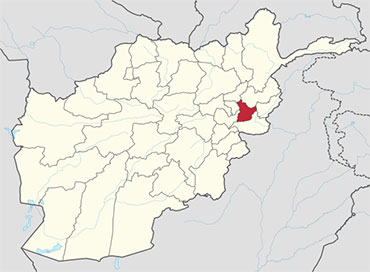
 Laghman is one of the 34 provinces of Afghanistan, located in the eastern part of the country. It has a population of about 445,600,[1] which is multi-ethnic and mostly a rural society. The city of Mihtarlam serves as the capital of the province. In some historical texts the name is written as "Lamghan" or as "Lamghanat".
History
Located currently at the Kabul Museum are Aramaic inscriptions that were found in Laghman which indicated an ancient trade route from India to Palmyra.[2] Aramaic was the bureaucratic script language of the Achaemenids whose influence had extended toward Laghman.[3] During the invasions of Alexander the Great, the area was known as Lampaka.
Inscriptions in Aramaic dating from the Mauryan Dynasty were found in Laghman which discussed the conversion of Ashoka to Buddhism.
In the seventh century, the Chinese pilgrim Xuanzang visited Laghman, which he called "Lan-p'o" and considered part of India. By the tenth century, Laghman was still connected to the Greater Indian world. Hudud al-'alam which was finished in 982 AD mentioned the presence of some idol worshipping temples in the area. According to Muslim historian al-Utbi, the region was converted to Islam towards the end of the tenth century by the Ghaznavids, led by Abu Mansur Sabuktigin.
Sabuktigin then won one of his greatest battles in Laghman against the Hindu Shahis whose ruler, Jayapala, had amassed an army for the battle that numbered 100,000.[9] The area later fell to the Ghurids followed by the Khilis and Timurids.
During the early years of the 16th century, the Mughal ruler Babur spent much time in Laghman, and in Baburnama (memoirs of Babur) he expatiated on the beauty of forested hillsides and the fertility of the valley bottoms of the region.[7] Laghman was recognized as a dependent district of Kabulistan in the Mughal era,[10] and according to Baburnama, "Greater Lamghanat" included the Muslim-settled part of the Kafiristan, including the easterly one of Kunar River. Laghman was the base for expeditions against the non-believers and was frequently mentioned in accounts of jihads led by Mughal emperor Akbar's younger brother, Mohammad Hakim, who was the governor of Kabul. In 1747, Ahmad Shah Durrani defeated the Mughals and made the territory part of the Durrani Empire. In the late nineteenth century, Amir Abdur Rahman Khan forced the remaining kafirs (Nuristani people) to accept Islam.
Healthcare
The percentage of households with clean drinking water fell from 39% in 2005 to 34% in 2011. The percentage of births attended to by a skilled birth attendant increased from 3% in 2005 to 36% in 2011.
Demography
The total population of the province is about 424,100, which is multi-ethnic and mostly a rural society. According to the Naval Postgraduate School, the ethnic groups of the province are as follows: 51% Pashtun, 21% Tajik, 27% Pashai and Nuristani (Kata). The people of Laghman are overwhelmingly Sunni Muslim.
Recent History
During the Soviet-Afghan war and the battles that followed between the rivaling warlords, many homes and business establishments in the province were destroyed. In addition, the Soviets are said to have employed a strategy that targeted and destroyed the agricultural infrastructure of Laghman.
As of 2007, an International Security Assistance Force Provincial Reconstruction Team led by the United States is based at Mihtarlam.
Economy
Agriculture and livestock husbandry are the primary occupations of the provinces residents. Fruit and vegetable are the most commonly farms items but there is also some cotton and sesame production. Farmers faced water shortages.
Men and women in Kunduz were employed in clothing production, metal working, carpentry and hide business.
The port of Shir Khan Bandar provides an international outlet for Kunduz's goods and has allowed for importing commercial goods from Asia, Middle East, and the Persian Gulf.
Healthcare
The percentage of households with clean drinking water fell from 25% in 2005 to 16% in 2011. The percentage of births attended to by a skilled birth attendant increased from 6% in 2005 to 22% in 2011.
Demographics
The population of Kunduz province is around 953,800,[2] which is multi-ethnic and mostly a tribal society. According to the Naval Postgraduate School, the ethnic groups of the province are as follows: Tajik 33%; Uzbek 27%; Pashtun 22%; Turkmen 11%; Hazara 6%; and Pashai 1%.
Another source gives the following: Tajik 34%; Pashtun 20%; Uzbek 27%; Turkmen 9.4%; Arab 4.6%; and Hazara 3.5%; plus small groups of Pashayi, Baloch and Nuristani.
Districts
Laghman province is divided into about 6 districts.
| District | Population | Area |
|---|---|---|
| Alingar | 98,764 | |
| Alishing | 72,844 | |
| Dawlat Shah | 33,962 | |
| Mihtarlam | 132,374 | |
| Qarghayi | 100,084 | |
| Badpash | 7,560 |