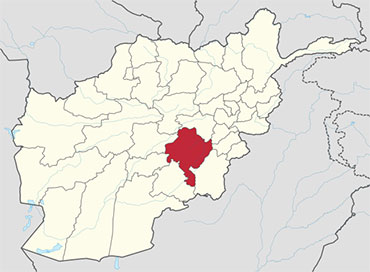
 Ghazni is one of the 34 provinces of Afghanistan, located in the southeastern part of the country. The province contains 19 districts, encompassing over a thousand villages and roughly 1.1 million people. The city of Ghazni serves as the capital. It lies on the important Kabul–Kandahar Highway, and has historically functioned as an important trade center. The Ghazni Airport is located next to the city of Ghazni and provides limited domestic flights to Afghanistan's capital, Kabul.
History
Ghazni was a thriving Buddhist center before and during the 7th century AD. Excavations have revealed religious artifacts of both Hindu and Buddhist traditions.
The two other great Buddhist centers, Fondukistan and Tepe-e-sardar (Ghazni) in its later phase are a very different matter and display another phase of influences coming from India from the seventh to eighth century. The representations show themes from Mahayana iconography and even in the case of the latter site assume Tantric aspects which had already established themselves in the large Indian monasteries like Nalanda.
Another important site is that of Tepe Sardar (better known as Tepe-yi Nagara, Tepe of the kettledrum) near Ghazni, which was occupied until perhaps the eighth century AD. From this period dates a huge statue of the Parinirvana Buddha (Buddha lying down at the end of his cycle of rebirths) of unbaked clay. A very similar statue has been found just north of Afghanistan, at the site of Adzhina tepe in Tajikistan. Yet what is most interesting was the find at the same site of a statue of the Hindu deity Durga Mahishasura-mardini.
In 644 AD, the Chinese pilgrim Xuanzang visited Jaguda, Ghazni, while travelling from the country of Varnu, crossing the land of O-po-kien (Afghans i.e. Pashtuns).
Islamization
In 683 AD, armies from the Umayyad Caliphate brought Islam to the area and attempted to conquer the capital of Ghazni but the local tribes fiercely resisted. Its resistance was so famed that Yaqub Saffari (840-879) from Zaranj made an example of Ghazni when he ranged the vast region conquering in the name of Islam. The city was completely destroyed by the Saffarids in 869. A substantial portion of the local population including Hindus and Buddhists were converted to Islam by Mahmud of Ghazni.
"There is no evidence that Ghazna had previously formed part of the Samanid kingdom. It had been previously overrun with the whole of Zabulistan and Kabul by the Saffaris by 260 (873) but it is doubtful how far their power was permanent and even when the Samanids became paramount there is no evidence that Kabul or Ghazna were under them. The ruler of Ghazna is described as Padshah and was allied to the Hindushahis of Kabul. These titles were not as yet used by the Muhammadan rulers. The Padshah Lavik was probably a Hindu chief even though some passages in the Tabakth i Nisiri give him the name of Abu Bakr or Abu Ali."
After the rebuilding of the city by Yaqub's brother, it became the dazzling capital of the Ghaznavids from 994 to 1160, encompassing much of North India, Persia and Central Asia. Many iconoclastic campaigns were launched from Ghazni into India. The Ghaznavids took Islam to India and returned with fabulous riches taken from both prince and temple god. Contemporary visitors and residents at Ghazni write with wonder of the ornateness of the buildings, the great libraries, the sumptuousness of the court ceremonies and of the wealth of precious objects owned by Ghazni's citizens.
Ferishta records attacks by Muhammad of Ghor: "at the same time most of the infidels who inhabited the mountains between Ghazni and the Indus were also converted, some by force and others by persuasion." Ghazni's eponymous capital was razed in 1151 by the Ghorid Alauddin. It again flourished but only to be permanently devastated, this time in 1221 by Genghis Khan and his Mongol armies after 6 years of Khwarezmid rule. Ghazni's strategic position, both economically and militarily, assured its revival, albeit without its dazzling former grandeur.
Ghazni is famous for its minarets built on a stellar plan. They date from the middle of the twelfth century and are the surviving element of the mosque of Bahramshah. Their sides are decorated with geometric patterns. Upper sections of the minarets have been damaged or destroyed. The most important mausoleum located in Ghazni is that of Sultan Mahmud's. Others include the tombs of poets and scientists, for example Al-Biruni and Sanai. The only ruins in Old Ghazni retaining a semblance of architectural form are two towers, about 43 m (140 ft) high and some 365 m (1,200 ft) apart. According to inscriptions, the towers were constructed by Mahmud of Ghazni and his son.
Babur records in his memoirs that Ghazni was part of Zabulistan. The area was controlled by the Mughals until Nader Shah and his Persian forces invaded it in 1738. Ahmad Shah Durrani conquered Ghazni in 1747 and made it part of the Durrani Empire. During the First Anglo-Afghan War, the capital of Ghazni province was destroyed by the British-led Indian forces in the Battle of Ghazni.
In the 1960s a 15-meter female Buddha was discovered lying on its back and surrounded by empty pillars that once held rows of smaller male Buddhas. Parts of the female Buddha have been stolen. In the 1980s a mud brick shelter was created to protect the sculpture, but the wood supports were stolen for firewood and the shelter partially collapsed.
Recent History
Since the US-led invasion of Afghanistan in October 2001, there has been a Provincial reconstruction base and a NATO forces base. These western forces (mostly Polish Armed Forces) are hunting Taliban and al-Qaida militants, who are still active in the area.
Like many southern Afghan provinces, Ghazni has a precarious security situation. The Taliban insurgents are found in the rural areas outside of the capital, and are involved in attacks on provincial schools and government infrastructure. The province has avoided the outright warfare seen in other provinces of Afghanistan such as Helmand and Kandahar, but that is due more to political expediency and the tactical plans of the NATO-led ISAF force than the existence of a stable security situation in the province. Ex-Governor Taj Mohammad was killed by insurgents in 2006 after being appointed police chief of the province with a mandate to quell the power of the Taliban. On the same day there was an unsuccessful attempt on the life of the governor at the time, Sher Alam Ibrahimi. There is a Polish and American Provincial Reconstruction Team base located in Ghazni.
In late April 2007, news agencies reported that Taliban fighters had taken control of Giro District in the province. The Taliban reportedly killed the district administrator, chief of police (who had been on the job for only one month) and three police officers. The Taliban withdrew from the district center one day later. In July 2007, 23 South Korean volunteers were kidnapped in the Ghazni province by the Taliban. Two of them were killed and their bodies were dumped in various places. As of August 1, security force was planned to be deployed to secure the release of those kidnapped. On September 28, 2010, the Deputy Governor of Ghazni and five others were killed after a suicide bomber on a motorized rickshaw attacked their vehicle. Deputy Governor Mohammad Kazim Allahyar and several men travelling with him were killed instantly when the attacker detonated his explosives at the back of their car near the airport in Ghazni City. The bodies were so badly burnt that there was some confusion about the identity of the other victims. Provincial police chief Delawar Zahid reported Allahyar's son, nephew and driver died, along with two civilians passing by on a bicycle. As of 26 September 2014, there is ongoing fighting in key districts between the Taliban and Afghan National Security Forces (ANSF).
Healthcare
The percentage of households with clean drinking water fell from 35% in 2005 to 18% in 2011. The percentage of births attended to by a skilled birth attendant increased from 7% in 2005 to 11% in 2011.
Demographics
As of 2013, the total population of the province is about 1,168,800, which is multi-ethnic and mostly a tribal society. According to the Institute for the Study of War, "Ghazni has nineteen districts and is one of the most ethnically diverse provinces in Afghanistan. Of the province’s one million residents, 90 percent are Pashtun or Hazara. Tajiks, Hindus and other ethnic minorities comprise the remaining ten percent of the population. While the Tajik population in Ghazni is small, it is concentrated in the provincial capital of Ghazni City, where 55 percent are Tajik, twenty percent are Pashtun, fifteen percent are Hazara, and a small percentage are Hindu." According to the Naval Postgraduate School, the ethnic groups of the province are as follows: 48.9% Pashtun, 45.9% Hazara, 4.7% Tajik, and less than 1% Hindu. The Pashtuns mostly belong to the Ghilji sub-group. Agriculture and animal husbandry are the primary occupation of the citizens of Ghazni. Wheat, alfalfa, melons, and almonds are among the largest crops produced.
Districts
Ghazni province is divided in to 19 districts.
| Province | Population | Area |
|---|---|---|
| Ab Band | Haji Khel | 26,700 |
| Ajristan | Sangar | 28,000 |
| Andar | Miray | 121,300 |
| Deh Yak | Ramak | 47,500 |
| Gelan | Janda | 56,200 |
| Ghazni | Ghazni | 157,600 |
| Giro | Pana | 35,500 |
| Jaghatu | Gul Bahawari | 30,900 |
| Jaghori | Sange-e-Masha | 171,600 |
| Khogyani (Wali Muhammadi Shahid) | Khogyani | 19,600 |
| Khwaja Umari | Kwaja Umari | 18,400 |
| Malistan | Malistan | 79,800 |
| Muqur | Muqur | 48,900 |
| Nawa | Nawa | 28,900 |
| Nawur | Du Abi | 91,900 |
| Qarabagh | Qarabagh | 138,800 |
| Rashidan | Rashidan | 17,500 |
| Waghaz | Waghaz | 37,500 |
| Zana Khan | Dado | 12,200 |