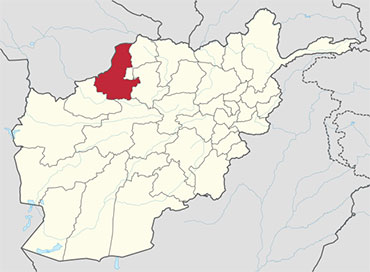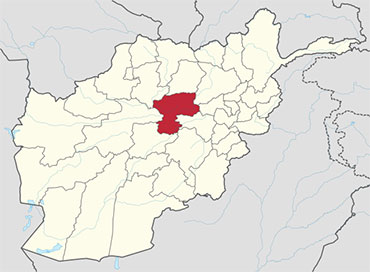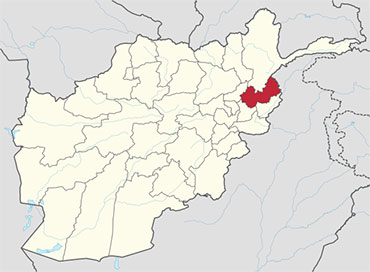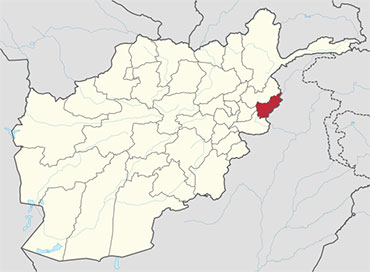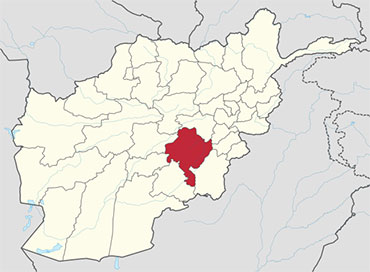
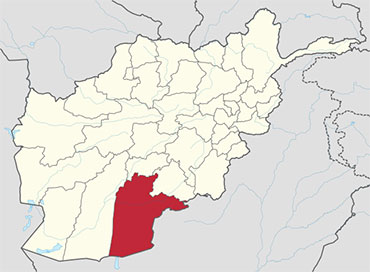
 Kandahar is one of the thirty-four provinces of Afghanistan, located in the southern part of the country next to Pakistan. It is surrounded by Helmand in the west, Uruzgan in the north and Zabul Province in the east. Its capital is the city of Kandahar, which is located on the Arghandab River.The province contains about 18 districts, over 1,000 villages, and approximately 1,151,100 people, which is mostly tribal and a rural society. The main inhabitants of Kandahar province are the native ethnic Pashtuns, although smaller communities of Tajiks, Hazaras, Uzbeks and Baloch are also found in parts of the city of Kandahar. The current governor of the province is Toryalai Wesa.
History
Excavations of prehistoric sites by archaeologists such as Louis Dupree and others suggest that the region around Kandahar is one of the oldest human settlements known so far.
The area was called Arachosia and was a frequent target for conquest because of its strategic location in Asia, which connects Southern, Central and Southwest Asia. It was part of the Medes territory before falling to the Achaemenids. In 330 BC it was invaded by Alexander the Great and became part of the Seleucid Empire following his death. Later it came under the influence of the Indian emperor Ashoka, who erected a pillar there with a bilingual inscription in Greek and Aramaic. The territory was ruled by the Zunbils before Arabs of the Umayyad Caliphate arrived in the 7th century.
The Arabs advanced through Sistan and conquered Sindh early in the eighth century. Elsewhere however their incursions were no more than temporary, and it was not until the rise of the Saffarid dynasty in the ninth century that the frontiers of Islam effectively reached Ghazni and Kabul. Even then a Hindu dynasty the Hindushahis, held Gandhara and eastern borders. From the tenth century onwards as Persian language and culture continued to spread into Afghanistan, the focus of power shifted to Ghazni, where a Turkic dynasty, who started by ruling the town for the Samanid dynasty of Bokhara, proceeded to create an empire in their own right. The greatest of the Ghaznavids was Mahmud who ruled between 998 and 1030. He expelled the Hindus from Ghandhara.
Mahmud of Ghazni made the area part of the Ghaznavids in the 10th century, who were replaced by the Ghurids. After the destructions caused by Genghis Khan in the 13th century, the Timurids established rule and began rebuilding cities. From about 1383 until his death in 1407, Kandahar was governed by Pir Muhammad, a grandson of Timur. By the early 16th century, it fell to Babur briefly. From then on the province was controlled as their easternmost territories by the Shia Safavids, who regularly had wars with the Sunni Mughals over the region, until the rise of Mir Wais Hotak in 1709. He rebelled against the Safavids and established the Hotaki dynasty which became a powerful Afghan empire until 1729 when Nader Shah declared war on the Ghilzai rulers. By 1738 the last Hotaki ruler Shah Hussain was defeated in what is now Old Kandahar.
Ahmad Shah Durrani, the founding father of Afghanistan, gained control of the province in 1747 and made the city of Kandahar the capital of his new Afghan Empire. In the 1770s, the capital of the empire was transferred to Kabul. Ahmad Shah Durrani’s mausoleum is located in the center of the city.
British-led Indian forces occupied the province during the First Anglo-Afghan War from 1832 to 1842. They also occupied the city during the Second Anglo-Afghan War from 1878 to 1880. It remained peaceful for about 100 years until the late 1970s.
During the Soviet occupation of 1979 to 1989, Kandahar province witnessed many fights between Soviet and local Mujahideen rebels. After the Soviet withdrawal the city fell to Gul Agha Sherzai, who became a powerful warlord and controlled the province.
At the end of 1994, the Taliban took over the area and set out to conquer the rest of Afghanistan. Since the removal of the Taliban government in late 2001, Kandahar again came under the control of Gul Agha Sherzai. He was replaced in 2003 by Yousef Pashtun followed by Asadullah Khalid and others. In the meantime, the United States established bases in the province. The various soldiers of International Security Assistance Force (ISAF) are also housed in the bases. The main base is at Kandahar International Airport. Their main objective is to train the Afghan National Security Forces (ANSF) as well as build government institutions and assist the local population.
In spring 2010, the province as well as its capital city became a target of American operations following Operation Moshtarak in neighbouring Helmand province. Kandahar has been the site of much of the violence in the War on Terror in Afghanistan.
Healthcare
The percentage of households with clean drinking water fell from 64% in 2005 to 32% in 2011. The percentage of births attended to by a skilled birth attendant fell from 16% in 2005 to 14% in 2011.
Demographics
The population of the province is about 1,151,100, which is mostly tribal and a rural society. The inhabitants of Kandahar province are ethnic Pashtuns, although smaller communities of Tajiks, Hazaras, Uzbeks and Baloch are also found in parts of the city of Kandahar. The main language spoken in the province is Pashto but in some urban centers Dari (Afghan Persian) is also in use as a second language.
Districts
Kandahar province is divided into about 18 districts.
| District | Population | Area |
|---|---|---|
| Arghandab | 53,205 | |
| Arghistan | 28,900 | |
| Daman | 24,800 | |
| Ghorak | 80,000 | |
| Kandahar | 512,200 | |
| Khakrez | 15,074 | |
| Maruf | 27,700 | |
| Maywand | 58,254 | |
| Miyanishin | 12,600 | |
| Nesh | 11,300 | |
| Panjwayi | 82,800 | |
| Reg | 1,600 | |
| Shah Wali Kot | 36,400 | |
| Shorabak | 9,600 | |
| Spin Boldak | 41,000 | |
| Zhari | 49,500 | |
| Shaga | ||
| Dand |