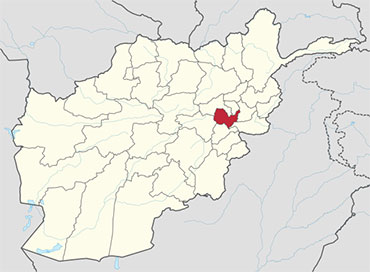
 Kabul situated in the east of the country, is one of the thirty-four provinces of Afghanistan. The capital of the province is Kabul city, which is also Afghanistan's capital. The population of the Kabul Province is nearly 4 million people as of 2012, of which almost 80 percent live in the urban areas. The current governor of the province is Ahmadullah Alizai.
Geography
Kabul is located between Latitude 34-31' North and Longitude 69-12' East at an altitude of 1800 m (6000 feet) above sea level, which makes it one of the world's highest capital cities. Kabul is strategically situated in a valley surrounded by high mountains at crossroads of north-south and east-west trade routes. One million years ago the Kabul region was surrounded from south-east between Lowgar and Paghman Mountains; Charikar in the north and the Ningai Ghar mountains in the west. This region formed an icy sea. Some deep wells in the region of today's Poli Charkhi in the east part of city are the evidence of that time. Kabul is surrounded by Koh-e Paghman Mountain from the east, Koh-e Qrough Mountain from the south-west and Koh-e Shirdarwaza Mountain from the north-east. Kabul has only one river which is called Kabul River. Kabul River rises at the Paghman Mountain toward South Pass about 70 km (43 mi) west of Kabul. It flows in an easterly direction, past Kabul, and through Jalalabad city, and then on to Dakka where it enters Pakistani territory and finally runs into the Indus at Attock.
The climate within region of Kabul is considered to be arid to semi-arid steppe. Because of the very low amounts of precipitation, especially from May to November, Kabul can be very dry and dusty. Extreme temperature changes occur from night to day, season to season, and from place to place. The chief characteristic of Afghanistan's climate is a blue cloudless sky with over 300 days of sunshine yearly. Even during the winter, skies usually remain clear between snowfalls, which are on average 15–30 cm (5.9–11.8 in) annually. The daily temperature for Kabul city in winter is −1 °C (30 °F) and in summer 24 °C (75 °F). The coldest month of the year is January and the hottest month is July. The maximum temperature has been recorded as +42.7 °C in July and the minimum as -26.3 °C in January.
History
Kabul's history dates back more than 3,500 years. It was once the center of Zoroastrianism and subsequently also a home for Buddhists and Hindus.
The native citizens of Kabul as per the records of the British Museum are Pashtuns and Tajiks.
The city was invaded by Arab Muslims in the 7th century by introducing Islam but was slowly taken back by the Hindu Shahi's of Kabul. It was re-invaded by the Saffarids and Samanids in the 9th century followed by Mahmud of Ghaznavi in the 11th century, when the Hindu Shahi King Jay Pala committed suicide. It became part of the Ghurids after defeating the Ghaznavids, and later it was invaded by the Mongols under Genghis Khan.
Timur, founder of the Timurid dynasty, invaded the region in 14th century and developed it into a major trading center. In 1504, the city fell to Babur from the north of the country and was made into his capital, which became one of the principal cities of his later Mughal Empire. In 1525, Babur described Kabulistan in his memoirs by writing that:
"In the country of Kābul there are many and various tribes. Its valleys and plains are inhabited by Tūrks, Aimāks, and Arabs. In the city and the greater part of the villages, the population consists of Tājiks (called "Sarts" by Babur). Many other of the villages and districts are occupied by Pashāis, Parāchis, Tājiks, Berekis, and Afghans. In the hill-country to the west, reside the Hazāras and Nukderis. Among the Hazāra and Nukderi tribes, there are some who speak the Moghul(mongol) language. In the hill-country to the north-east lies Kaferistān, such as Kattor and Gebrek. To the south is Afghanistān the Pashtoon tribe which makes the largest majority in the country and in Kabul province. There are different Tribes of Pashtoons living in Kabul... There are eleven or twelve different languages spoken in Kābul: Arabic, Persian, Tūrki, Moghuli, Hindi, Afghani, Pashāi, Parāchi, Geberi, Bereki, and Lamghāni"
For much of its time Kabul was independent until it became part of the Durrani Empire in 1747. During the First Anglo-Afghan War in 1839, the British army invaded the area but withdrew in 1842, although thousands of them were killed during a surprise ambush on their way to Jalalabad. In retaliation another British force partly burned Kabul before retreating back to British India. The British again occupied the city during the Second Anglo-Afghan War in 1879, after their resident staff were massacred there, but withdrew about a year later when they installed Emir.
In 1919, King Amanullah Khan rose to power during the Third Anglo-Afghan War when Afghanistan's capital and its eastern city of Jalalabad were air raided by the No. 31 and 114 squadrons of the British Royal Air Force in May 1919. Amanullah Khan defeated the British and began modernization of the country after the signing of the Treaty of Rawalpindi. In the late 1920s, switching of power took place until Zahir Shah became the youngest new King.
In the 1960s and 1970s, Kabul was known as the Paris of central Asia as it was transforming into a European style city. Once the jewel of Asia, a very progressive and moderately modern capital. Kabul in those days had, modern cinemas, cafes, formal French gardens, schools, libraries, universities, fine boutiques. The inhabitants of Kabul known as "Kabulis" were highly educated, modern, progressive and cosmopolitan people. Where women and men attended primary school, high school and university. Mini-jupes (mini skirts) were a common sight in the 1970s. Highly educated, culturally aware and yet religious at the same time, there was never an issue with not having your hair covered or the clothes you wore in the Kabul of the 1960s and 1970s. This progressive peaceful society lasted until foreign interference occurred in the late 1970s plummeting the country to what Afghanistan has become today. In December 1979, Soviet armed forces landed at Kabul International Airport to help bolster the PDPA-led government of Afghanistan.
Mujahideens. In spring of 1992 the government of Mohammad Najibullah collapsed, Kabul fell into the hands of Mujahideen forces. Destruction increased as the coalition of the parties broke into rival warring factions, and much of Kabul was damaged. In 1996 the Taliban took over the region and started a new strict Islamic Sharia rule which restricted most forms of education, entertainment, women from working, men from shaving beards, and many normal human activities or hobbies.
Less than a month after the September 11 attacks in the United States, in October 2001, the United States armed forces assisted by British Armed Forces provided massive air support to United Front (Northern Alliance) ground forces during Operation Enduring Freedom. The Taliban abandoned Kabul and the United Front came to take control of the city. In December 2001 Kabul became the capital of the Afghan Transitional Administration, which transformed to the present Government of Afghanistan that is led by President Hamid Karzai.
In early 2002 a NATO-led International Security Assistance Force (ISAF) was deployed in Kabul and from there they began taking over other parts of the country. The war-torn city began to see some positive development as millions of expats returned to the country. Its population has grown from about 500,000 in 2001 to over 3 million by 2007. Many foreign embassies re-opened, especially the biggest U.S. Embassy. Afghan government institutions were also re-developed and modernized. Since 2008 the newly trained Afghan National Police (ANP) and the Afghan National Army (ANA) are in charge of security in the area, while NATO also has a heavy presence but are not patrolling the streets anymore.
While the city is being developed, it is also the scene of occasional deadly suicide bombings and explosions carried out by the Haqqani network, Taliban's Quetta Shura, Hezb-i Islami, Al Qaeda, and other anti-government elements who are allegedly supported and guided by Pakistan's Inter-Services Intelligence (ISI) spy network.
Economy
Kabul's products include: natural gas, cotton, wool, carpets, agriculture, and some small production companies. Kabul has trade partnerships with the UK, France, Germany, United States, India, South Korea, Turkmenistan, Kenya, Russia, Pakistan, China, Iran. Kabul's economy was influenced by the America and has increased by almost 3500% after shrinking for 25 years. A new currency was introduced to Afghans which helped the economy. New business was in the new regime. Many American industries were interested in the new Kabul and many new companies have since then opened their branches in Kabul. The Kabul City Centre Mall was built and has nearly 100 shops.
The economy is at a boom level and is increasing dramatically. Housing costs are rising as are employee wages. The cost of living has increased dramatically which is a problem for the non-educated Afghans, who cannot support themselves. The UN helps Afghans in need of help by providing aid, food and school materials for schools. Many international aid organizations are contributing to the Afghan economy.
Demographics and administration
The total population of Kabul province is 3,950,300, of which about 80 percent live in the urban areas (mainly in the Kabul metropolitan area) while the remaining 20 percent are rural residents.
The Afghan Ministry of Rural Rehabilitation & Development estimates that approximately 60% of the province belongs to the Pashtun people in terms of area. The city of Kabul is multi-ethnic, with 45% Tajiks, 30% Hazaras, 20 % Pashtuns, 2% Uzbeks, 1% Baloch, 1% Turkmen, and 1% others. Dari and Pashto language are widely used in the region although Dari serves as the lingua franca. Multilingualism is common throughout the area, particularly among the Pashtun people.
About 85% of the population follow Sunni Islam while 14% are Shiites. The remaining 1% are followers of Sikhism, Hinduism and other religions. The major Pashtun tribes in the province are the Ghilji, Shinwari, Khugyani, Wardak and Safi.
Districts
Kabul province is divided into about 15 districts.
| Province | Population | Area |
|---|---|---|
| Bagrami | 85,000 | |
| Chahar Asyab | 32,500 | |
| Deh Sabz | 47,900 | |
| Farza | 19,100 | |
| Guldara | 25,213 | |
| Istalif | 29,800 | |
| Kabul | 3,289,000 | |
| Kalakan | 26,900 | |
| Khaki Jabbar | 75,000 | |
| Mir Bacha Kot | 46,300 | |
| Mussahi | 30,000 | |
| Paghman | 150,000 | |
| Qarabagh | 67,700 | |
| Shakardara | 72,900 | |
| Surobi | 150,000 |